搜索排名机制说明
Crawling, indexing, ranking, and which of the three you actually control. 影响项: SEO
What happens between your site and a results page
Search engines work in three stages. First they crawl: automated software follows links and sitemaps to fetch pages. Then they index: fetched pages are parsed, understood and stored. Only then do they rank: for each query, indexed pages are ordered by hundreds of signals: relevance to the words used, content quality and depth, page experience, and what the rest of the web says about you.
The crucial insight: the first two stages are almost completely under your control. If crawlers are blocked in robots.txt, if pages carry a noindex tag, or if your site has no sitemap and poor internal links, nothing downstream can work; the best content on earth ranks nowhere if it was never indexed.
What this site measures
Our search-visibility category checks the controllable foundation: robots.txt access, noindex directives, an XML sitemap, canonical URLs, HTTPS redirects, one canonical host, and real 404 handling. These are pass/fail facts, not opinions; each check shows exactly what our crawler saw on your site.
How to improve
- Make sure robots.txt doesn't block sections you want found.
- Publish an XML sitemap and reference it from robots.txt.
- Declare one canonical host (www or bare domain) and redirect the other.
- Return real 404 status codes for missing pages so error pages aren't indexed.
- Link every important page from your navigation or homepage.
- Use Google Search Console (free) to see exactly how Google crawls and indexes you.
Common mistakes
A staging noindex tag that ships to production and silently removes the whole site from results. A blanket 'Disallow: /' left in robots.txt. Both www and non-www serving the same content as duplicates. Soft 404s, error pages that return 200 and get indexed as real content.
查看您的网站在此项的表现: 为其评分,每项检测均展示其依据。
为我的网站评分 →更多指南
打造易于被发现的网站
Starting from zero? The platform choices, pages and foundations that decide whether your site is visible from day one.
阅读完整指南 →
按正确顺序持续优化您的网站
The improvement playbook: what to fix first, what compounds, and how to verify each step actually landed.
阅读完整指南 →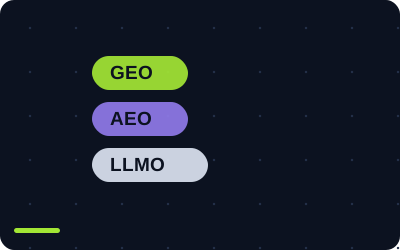
GEO、AEO 与 LLMO:全面解读这套新兴术语体系
The three terms you'll hear most for AI-era optimization: what each means, how they differ, and what to actually do about them.
阅读完整指南 →
AI 与答案引擎(AIO)
A growing share of questions never reach a results page; an assistant answers them.
阅读完整指南 →
标题与 meta 描述
Your headline and your sales pitch in every results page and AI citation.
阅读完整指南 →
速度与核心网页指标
Slow pages lose visitors before they load, and page experience feeds rankings.
阅读完整指南 →